Complete daily slate
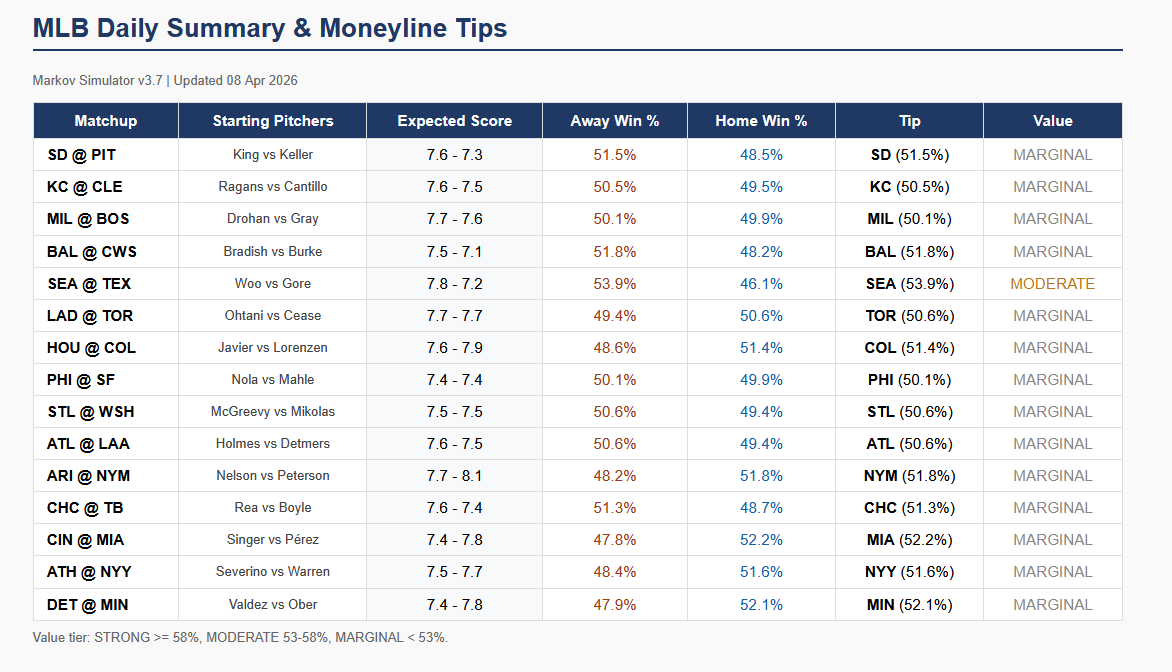
The day’s MLB matchups processed through the simulation engine.

MLB Season Ratings
Baseball isn’t just a set of averages. This engine models the sequence of base-out states that make up an inning, then simulates each matchup 10,000 times.
US$30/month · Daily MLB slate · Model estimates are informational only.
What you get
The day’s MLB matchups processed through the simulation engine.
Outright model probabilities for each matchup.
Expected run output for both teams.
Probability and model-implied-price views across alternate run lines and totals.
Get the product
US$30/month
Checkout and digital delivery are handled through Math & Bets on Gumroad.
Under the hood
The engine represents baseball through its 24 base-out states and models how innings transition from one state to another.
Starting-pitcher transition matrices are built from recent rolling performance, with contextual noise filtered where possible.
The simulation switches from the starter to a team bullpen matrix for the late innings.
Modern extra innings are modelled with a runner beginning on second base in the 10th inning.
Each matchup is simulated repeatedly to form win, run and alternate-market probability distributions.
FAQ
The engine is state-based: it models how baserunners and outs evolve through an inning rather than relying only on aggregate averages.
Starting pitchers and team bullpens use separate transition structures within the simulation.
The product is designed around the MLB daily schedule.

Math & Bets
Use the model as a second opinion — then decide for yourself.